
Enterprise Platform Modernization
A production-informed case study on incrementally modernizing mature enterprise workflows using Next.js, serverless APIs, reusable frontend patterns, and clearer frontend–backend ownership boundaries.
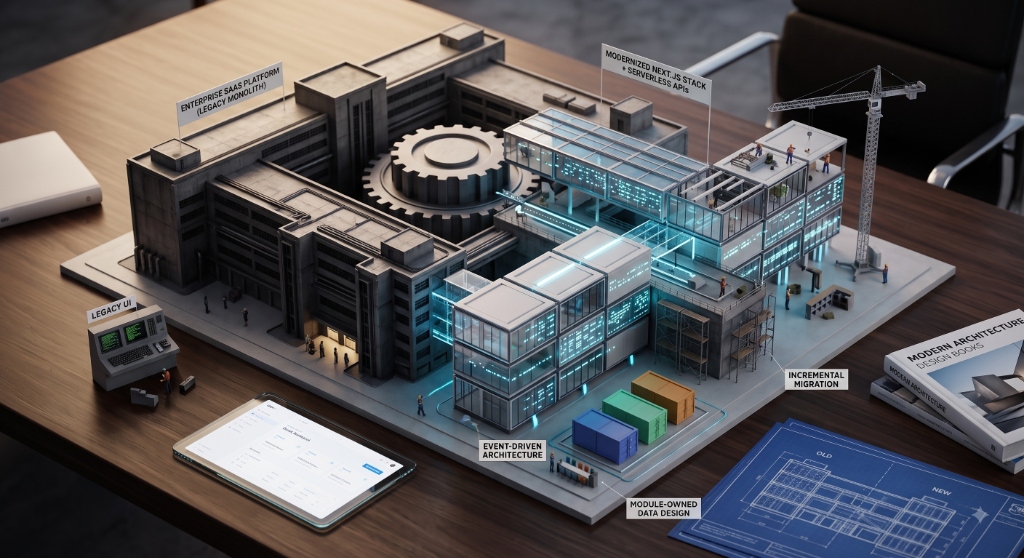
Public-Safe Note
This case study intentionally avoids company-specific names, internal service names, private architecture details, production scale figures, and confidential business metrics. It focuses on the modernization patterns, product-engineering trade-offs, and contributions I can discuss publicly.
The Situation
A mature enterprise SaaS platform had data-intensive workflows that had accumulated tighter frontend, backend, and data dependencies over time, making some product areas harder to evolve consistently as complexity grew.
Incremental Modernization
Selected workflows were modernized incrementally using Next.js, reusable frontend patterns, serverless service boundaries, and asynchronous processing where it fit the workflow.
Scalable Foundation
The modernization created clearer product and service boundaries, more consistent UX patterns, and a stronger foundation for maintainability, independent evolution, and safer product delivery.
Why modernization was needed
The workflows had the common complexity of a mature enterprise product: data-intensive screens, interaction-heavy interfaces, evolving frontend–backend dependencies, inconsistent implementation patterns across older areas, and shared platform boundaries that made isolated change more difficult.
The modernization goal was not simply to replace one technology with another. Next.js and serverless APIs were part of the implementation approach, but the broader goal was to improve product responsiveness, create clearer service boundaries, reduce unnecessary coupling, improve UX consistency, and make future product delivery easier to evolve safely.
Data-intensive workflows
Some product areas had to present and manipulate large operational datasets, which made data flow, rendering strategy, and interaction design important parts of the modernization work.
Interaction-heavy interfaces
Search, filtering, tables, forms, and operational actions needed predictable behavior even when the underlying workflows involved substantial data and multiple backend interactions.
Shared runtime boundaries
Multiple product workflows shared broader platform runtime boundaries, so the modernization introduced more isolated service boundaries where independent ownership and execution were useful.
Cross-module data dependencies
Mature product areas naturally accumulate shared data dependencies. Clearer ownership boundaries help reduce coordination cost and make individual modules easier to reason about and evolve.
Delivery consistency
Reusable UI patterns, clearer API contracts, and better-defined ownership boundaries were important for making similar workflows more consistent to build, review, and maintain.
My role & what modernization focused on
My role in the modernization effort has been to deliver product modules end-to-end within the evolving platform architecture — building reusable frontend patterns, integrating with serverless APIs, improving frontend–backend contracts, and contributing to workflows where UX consistency, responsiveness, and long-term maintainability matter.
The sections below deliberately separate broader platform context from the areas I directly contribute to. I focus on implementation patterns, integration boundaries, product-level trade-offs, and the engineering decisions I can discuss confidently without exposing private system details.
Frontend workflow modernization
Built and migrated selected product workflows in Next.js using reusable UI, validation, loading, error, and state-handling patterns.
Serverless service boundaries
Integrated product workflows with serverless API boundaries, helping keep frontend responsibilities, backend contracts, and service ownership easier to reason about.
Event-driven processing
Worked with asynchronous and event-driven processing patterns where workflows benefited from decoupling longer-running or non-blocking work from the immediate user interaction.
Module-owned data design
Worked within clearer module and service data-ownership boundaries so product areas could evolve with fewer unnecessary cross-module dependencies.
Cleaner API contracts
Improved frontend–backend communication by making request shape, response shape, validation, error handling, and ownership easier to reason about.
Incremental rollout
Delivered within an incremental migration model where established and modernized workflows could coexist, reducing the risk of an all-at-once replacement.
Modernization pattern & delivery flow
The broader modernization follows a gradual replacement model rather than an all-at-once rewrite. Established workflows continue to operate while selected product areas are rebuilt behind clearer frontend, API, and service boundaries.
Understand the legacy workflow, user journey, and backend dependency chain
Identify high-friction, repeated, or tightly coupled interaction patterns
Separate frontend concerns from backend service boundaries
Define reusable frontend structures and shared UX patterns
Create cleaner API contracts for migrated workflows
Integrate with serverless service boundaries used by the modernized workflow
Use asynchronous or event-driven processing where the workflow benefits from decoupling
Work with clearer module-owned data boundaries where independent evolution matters
Handle loading, error, empty, and stale states consistently
Release incrementally without disrupting existing workflows
Architecture trade-offs in the modernization
The modernization involves trade-offs between delivery speed, migration risk, operational complexity, ownership boundaries, and long-term maintainability. These are the trade-offs I work within and reason about when delivering migrated product areas.
Incremental migration over full rewrite
A full rewrite may look cleaner on paper, but it carries high delivery risk. Incremental modernization allowed newer modules to be built while existing workflows continued to run.
Serverless boundaries vs shared runtime
Separating selected capabilities behind serverless boundaries can improve isolation and deployment ownership, while also introducing distributed-system concerns such as observability, retries, and cross-service coordination.
Event-driven flows over synchronous coupling
Not every workflow needs to be synchronous. For selected operations, event-driven processing reduces direct coupling, absorbs spikes better, and makes retries/failure handling more explicit.
Clearer data ownership vs broad shared access
Shared data access can simplify coordination early on, while clearer module ownership can reduce coupling as product areas evolve. The trade-off is additional responsibility around contracts, synchronization, and operational ownership.
Reusable patterns over one-off screens
One-off implementation is faster in the first module, but reusable frontend and integration patterns reduce repeated effort when multiple product modules share similar behavior.
UX responsiveness over framework migration alone
The migration was not only about adopting Next.js or serverless. The real value was improving how users experience data-heavy workflows and how engineers evolve them safely.
Engineering outcomes
I do not publish private production metrics or invent benchmark numbers. The value of the work is better represented through the engineering outcomes that can be discussed safely:
UX responsiveness
Modernized workflows use clearer data flow, reusable rendering patterns, and more predictable loading, error, empty, and interaction states.
Backend scalability
Clearer service boundaries support more isolated execution and scaling characteristics without requiring every product workflow to move together.
Concurrency handling
Asynchronous and serverless patterns provide clearer ways to separate non-blocking work, retries, and variable workloads from immediate user-facing interactions.
Maintainability
Cleaner module structure, reusable patterns, and clearer ownership boundaries made similar workflows easier to build, review, and evolve.
Delivery confidence
Incremental delivery allows modernized product areas to move forward without requiring a single high-risk replacement of established workflows.
Cost model awareness
The move toward managed and serverless components created a more usage-aligned architecture, while still requiring measurement to validate exact cost impact.
How I evaluate modernization progress
Because internal production metrics are not appropriate to publish here, I use a measurement framework that compares baseline and post-migration behavior across the areas that matter for each workflow:
Modernization is a product, architecture, and delivery problem — not only a framework migration.
Good modernization work is not just rewriting screens or adopting a newer framework. It is about making complex workflows easier to use and evolve, reducing future delivery friction, improving maintainability, creating clearer ownership boundaries, and helping teams move with more confidence.
Thinking about modernizing a legacy product?
I’m open to meaningful conversations around legacy modernization, frontend–backend ownership boundaries, serverless architecture, event-driven workflows, and safer incremental migration paths.